Mechanical Engineering Ph.D. Candidate Wins 2026 Three Minute Thesis Competition
By Katya Hrichak
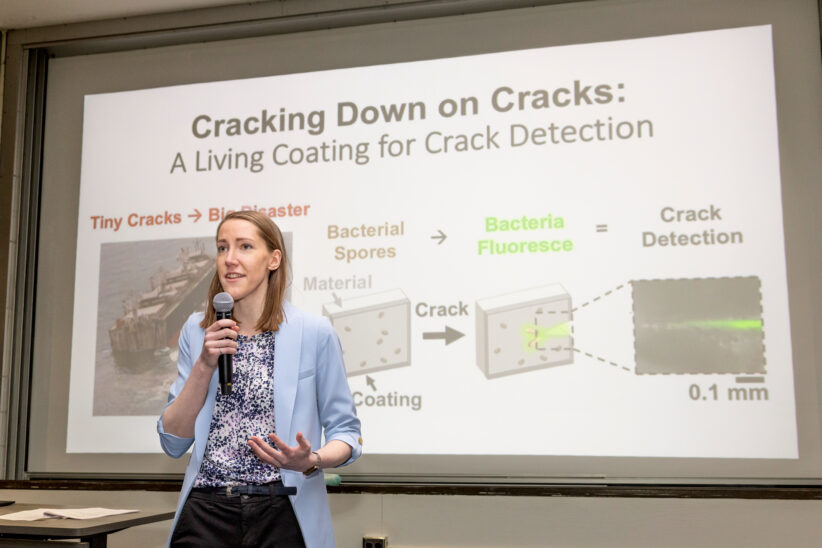
Photo courtesy of Simon Wheeler for Cornell University
“I hate to break it to you, but failure is inevitable—failure of materials, that is,” began Ellen van Wijngaarden, a mechanical engineering doctoral candidate, at the 11th Cornell University Three Minute Thesis (3MT) competition.
Alongside eight other finalists, van Wijngaarden presented her dissertation research in just three minutes on March 18 to a panel of judges and an audience from across campus while additional friends, family, advisors, and research group members watched online. Presentations were judged by how clearly and compellingly students summarized their research to a general audience, using only one static slide.
Van Wijngaarden’s presentation, “Cracking Down on Cracks: A Living Coating for Crack Detection,” earned her first place and $1,500. Second place and $1,000 was awarded to Subash Bhandari, a doctoral candidate in biomedical engineering for his presentation, “Fight Night: Nodes vs. Invaders.”
After nearly 170 in-person and virtual audience members cast their ballots, votes were tallied and the People’s Choice Award and $250 were presented to biomedical engineering doctoral candidate Aminat Ibrahim for her presentation, “Beyond Survival: Designing Living Heart Valves.”
The judges for Cornell’s 3MT included Erica Kryst, executive director of Cornell Career Services; Seph Murtagh, Ph.D. ’09, director of development for Catholic Charities of Tompkins/Tioga; Laura Reiley, writer for the Cornell Chronicle and host of the new Research Matters podcast; and Mark Sarvary, Ph.D. ‘06; Stephen H. Weiss Provost’s Teaching Fellow and director of the investigative biology teaching laboratories in the department of neurobiology and behavior. The competition was organized by the Graduate School Office of Career and Professional Development.
“I think it’s a really important exercise to communicate what you study,” said van Wijngaarden. “If you can’t explain what you study or research to an average person—I usually say to my grandmother—then you don’t really understand it. Doing a competition like this forces you to exercise that skill.”
Bhandari and Ibrahim, both of whom set a personal goal years ago to participate in a 3MT competition, also appreciated the challenge of conveying their research to a broad audience.
“It takes so much more time and lots of reiterations to craft a three minute pitch than it takes for you to prepare an hourlong presentation,” Bhandari said. “Valuing the art of scientific storytelling and putting your audience in your shoes when you’re thinking about communication is really important.”
In addition to enjoying the ability to practice presenting research to nonscientific audiences, Ibrahim enjoyed being part of the audience herself during the other finalists’ presentations and learning about research taking place across campus outside of her own field.
“You always have something to learn,” she said. “Looking at other people’s research, those are really amazing research projects going on here now.”
The 3MT competition was first held in 2008 at the University of Queensland and has since been adopted by over 900 universities in 85 countries. 3MT challenges research degree graduate students to present a compelling story on their dissertation or thesis and its significance in just three minutes, in language appropriate to a nonspecialist audience.
Cornell’s Graduate School first hosted a 3MT competition in 2015 and the event has grown steadily since that time. As the winner of Cornell’s competition, van Wijngaarden will now go on to compete in northeast regional competitions and the Ivy 3MT.
“Every one of our finalists did an excellent job taking their sophisticated, groundbreaking research and transforming it into a presentation that the general public could understand,” said Thomas A. Lewis, dean of the Graduate School and vice provost for graduate education. “This was my first 3MT as dean, and I am already looking forward to hearing what our students come up with next year.”