Alum Spotlight: Jiameng Lai, Ph.D. ’25
March 12, 2026
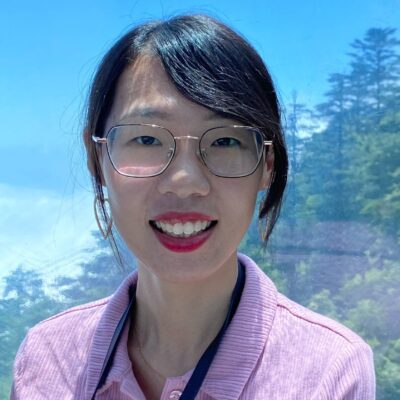
Jiameng Lai, Ph.D. ’25, is an alum of the soil and crop sciences doctoral program. She is now an Environmental Postdoctoral Fellow at Harvard University.
What was your research focus at Cornell?
My research at Cornell explored the complex interactions between the terrestrial carbon-water-energy nexus, human activities, agricultural practice, and climate change at multiple scales. In particular, my Ph.D. dissertation developed a model-based framework to better infer terrestrial carbon-water exchanges (e.g., photosynthesis and water use efficiency) using innovative tracers (e.g., carbonyl sulfide and carbon-13 isotopes).
What is the broader implication of this research and how is it making an impact?
Plants face a critical dilemma: To grow, they must open stomata—tiny pores in their leaves—to absorb carbon dioxide from the air, but this causes them to lose precious water. This delicate balance between carbon uptake and water loss affects many processes from agricultural activities to global climate patterns. However, scientists have long struggled to understand this balance beyond canopy scales, leading to significant uncertainties in our understanding of how much carbon plants absorb globally and how efficiently they use water. My research addresses this challenge by integrating two innovative natural tracers that plants consume through pathways coupled with CO2 and H2O diffusion—carbonyl sulfide (OCS) and carbon-13 isotope (13C). Through a unified modeling framework that constrains large-scale terrestrial carbon-water fluxes using both tracers, my research enhances our predictive understanding of carbon-water interactions.
Tell us about your current position and what you find rewarding about it.
I am currently a postdoc in the lab of Prof. Paul Moorcroft at Harvard, supported by the Environmental Fellowship at Harvard University Center for the Environment (HUCE). I got the offer at a challenging time when many universities have announced hiring freezes, so this position is extremely meaningful. Besides, this fellowship program gives me freedom to work on the project that I am most interested in and also allows me to work with great teams with access to world-class academic resources.
What does it mean to you to have been selected as a first-place winner of the SUNY Chancellor’s Dissertation Award?
This is truly a great honor to me, especially when I knew that I was the first Cornell student to receive this award! It strengthened my confidence and affirmed that my years of dedicated work were making a significant contribution to the field. Conducting research is challenging and exhausting, but the moment when the work receives attention and recognition makes every effort worthwhile.
What will this award allow you to do that you may not have otherwise?
This award gives me the courage to pursue even more ambitious work as a postdoc. My current work builds directly on my dissertation, so this recognition affirms both my past contributions and my vision for where this research can go—making me more confident in tackling the challenging questions ahead.
What do you enjoy doing outside of work?
Travel, hanging out with friends, and playing Mahjong (a tile-based game that was developed in the 19th century in China).
If you could go back in time to the beginning of your graduate school journey, what advice would you give yourself?
Be confident and trust yourself. Spend more time in practicing the English language. Think more, do less.