
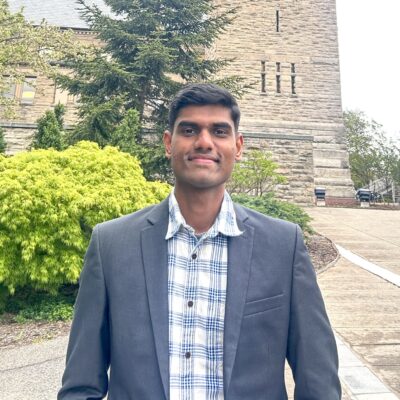
Student Spotlight: Divyanth Loganathan Girija
June 29, 2026
Divyanth Loganathan Girija is a doctoral student in biological and environmental engineering from Thanjavur, Tamil Nadu, India. He earned his B.Tech from the Indian Institute of Technology in Kharagpur, India and M.S. in agricultural and biological engineering from Washington State University, Pullman and now studies the development of intelligent robotic and AI-enabled systems for agriculture under the guidance of Manoj Karkee in the Agricultural Robotics Lab at Cornell.
What is your area of research and why is it important?
My research focuses on developing intelligent robotic and AI-enabled systems for agriculture. Modern agriculture faces major challenges, including labor shortages, rising production costs, limited water resources, climate variability, and increasing pest and disease pressures. Many essential tasks such as harvesting, pruning, thinning, crop monitoring, and nutrient and chemical application still rely heavily on manual labor and are resource intensive. I design robotic platforms equipped with advanced sensors, artificial intelligence, and automated tools that can navigate agricultural environments, monitor crop conditions, and perform targeted operations with precision. These technologies help farmers improve efficiency, reduce waste, optimize resource use, and support sustainable agricultural production.
What are the larger implications of this research?
The broader impact of my research is the development of more sustainable, resilient, and efficient agricultural systems. By integrating robotics, artificial intelligence, and advanced sensing technologies into farming operations, this work can reduce dependence on manual labor while minimizing the use of water, fertilizers, and agrochemicals. These systems also enable farmers to make more informed, data-driven decisions that improve crop yield and quality while reducing environmental impact. Beyond production agriculture, my research supports scalable crop monitoring and plant phenotyping, which can accelerate breeding and crop improvement efforts. Ultimately, this contributes to global food security, environmental sustainability, and stronger farming communities worldwide.
What does it mean to you to have been selected for the FFAR Fellows Program?
Being selected for the FFAR Fellows Program is both an honor and an important milestone in my professional journey. It represents recognition of the importance and potential impact of my research on agricultural automation. More importantly, the program provides an opportunity to join a community of emerging leaders who are committed to solving critical challenges in food and agriculture. I value the interdisciplinary nature of the program because advancing agricultural technologies requires collaboration among engineers, plant scientists, breeders, policymakers, and industry leaders. This fellowship motivates me to continue pursuing research that creates practical and meaningful impacts on agriculture and society.
What will participating in the FFAR Fellows Program allow you to do that you may not have been able to otherwise?
The FFAR Fellows Program will provide a unique environment to develop leadership, communication, and interdisciplinary collaboration skills essential for a successful career in agricultural engineering. The self-assessment and professional development components of the FFAR Fellows Program will help me understand my leadership strengths and areas for growth as I move toward roles that combine research, technology translation, and team leadership. As my work spans robotics, plant science, and breeding programs, strengthening my ability to communicate across disciplines is essential to ensure that engineering solutions address real agricultural needs.
The program’s mentoring structure is particularly valuable for my career goals. I am pursuing career paths bridging academia and industry, as reflected by my upcoming co-op with Bayer Crop Science. Learning from industry scientists and leaders through the FFAR network would provide perspective on how research innovations progress from laboratory prototypes to field-scale agricultural technologies. Moreover, engagement in policy discussions would broaden my understanding of how research, innovation, and policy interact to shape the future of food and agriculture, enabling me to design solutions that are both technically robust and practically adoptable.
What are your hobbies or interests outside of your research or scholarship?
Outside of research, I enjoy sports, mentoring, and community engagement. I have training in badminton, squash, and swimming, and these activities help me maintain balance and mental clarity. I also enjoy reading religious and philosophical literature, which has been a steady source of inspiration and perspective throughout my journey. Volunteering and mentorship are especially meaningful to me. I actively mentor junior students and have volunteered in underserved communities, experiences that strengthened my patience and ability to simplify complex ideas.
Why did you choose Cornell to pursue your degree?
I chose Cornell University because of its strong interdisciplinary environment and leadership in agricultural engineering, robotics, and digital agriculture. In particular, the Cornell Institute for Digital Agriculture provides an ideal platform for advancing research in precision agriculture, agricultural robotics, and AI-driven farming technologies. Cornell’s collaborative ecosystem allows researchers from engineering, plant science, and data science to work together on real-world agricultural challenges, which strongly aligns with my research interests and career goals. I was also drawn to Cornell’s emphasis on translating research into practical field applications and its strong connections with growers, industry, and research institutions, making it an excellent environment to grow both academically and professionally.