
Student Spotlight: Gauri Nagpal
April 30, 2026
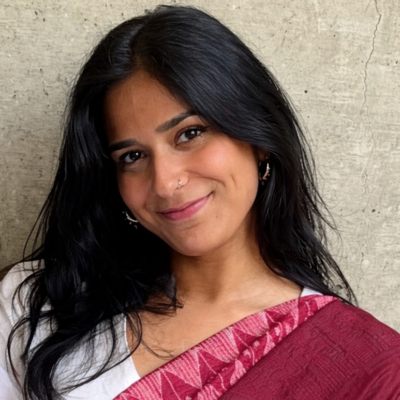
Gauri Nagpal is a doctoral student in city and regional planning from Chandigarh, India. She completed a fellowship at the Indian Institute for Human Settlements and earned a dual master’s degree in urban planning and design studies at Harvard University and now studies how carbon markets are used to finance climate action in the Global South under the guidance of Sophie Oldfield.
What is your area of research and why is it important?
Climate change is creating new forms of debt in the Global South – here, nearly all finance for climate action arrives as loans. My research examines how cities in the Global South are using carbon markets to finance infrastructure in contexts where development needs and fiscal constraints are deeply intertwined. I focus on elite networks of consultants and bureaucrats or “carbon brokers,” who translate emissions reductions into tradable credits and, in doing so, shape how climate value is defined and exchanged. While this work may appear technical, it has deeply political consequences for which urban projects get funded and whose priorities are represented. By tracing how carbon gets converted into credit, I show that the ostensibly deterministic domain of emissions reporting, registration, and exchange rests on practices of speculation, obfuscation, and tactical negotiation. As cities face growing climate risks but limited debt-free finance, understanding these dynamics is increasingly important.
What are the larger implications of this research?
This research asks us to reconsider how we understand climate solutions and their uneven effects. Carbon markets often enable wealthier actors to offset emissions through projects in lower-income regions, raising enduring questions of justice and accountability. But cities in the Global South are not simply sites where these logics arrive – they are places where they are negotiated, unsettled, and often reworked. In contexts marked by fiscal constraint and austerity, cities engage market-based mechanisms in strategic ways, reshaping development priorities in the process. Attending to these practices reveals the Global South as a crucial site for understanding the evolving fiscal politics of climate action.
What does it mean to you to have been selected as a Mellon/ACLS Dissertation Innovation Fellow?
Being selected for this fellowship is deeply meaningful because it recognizes both the intellectual and public-facing ambitions of my work. The Mellon/ACLS Dissertation Innovation Fellowship supports projects that push beyond traditional academic formats, which aligns closely with my goal of making research accessible to broader audiences. It also affirms the importance of studying climate change from the perspective of cities in the Global South. Personally, it is an encouraging reminder that the questions I care about around power and inequality in the urban resonate beyond my discipline and are worth pursuing with rigor and creativity.
What will this fellowship allow you to do that you might not have otherwise?
This fellowship will allow me to conduct in-depth, multi-sited fieldwork in India and South Africa, working closely with institutions and actors involved in carbon finance. It also enables me to experiment with new forms of research communication, including podcasts and animated shorts, which would be difficult to pursue within the constraints of a traditional dissertation. These formats are especially important for reaching practitioners and communities directly affected by climate finance who may not have access to academic publications. The fellowship expands both the scope and impact of my research.
What are your hobbies or interests outside of your research or scholarship?
I love watching cinema and working with visual storytelling, often through experiments in illustration, animation, and sound. I’m also drawn to design projects that take shape through everyday engagements with people, especially those rooted in my hometown of Chandigarh. Much of what I value is shaped by companionship, and after a long day of classes, this often carries over to the gym with my friends Eve and Julia, where our conversations, like most good ones, resist neat boundaries and simply find new rooms to continue in. 😊
Why did you choose Cornell to pursue your degree?
A central reason I came to Cornell was the opportunity to work with my advisor, Prof. Sophie Oldfield, in a department where critical theory and practice are treated as entangled domains through which urban questions are worked out. This has allowed me to approach my research with both theoretical rigor and a sustained attention to lived realities. What has made this experience truly formative, however, is the intellectual life beyond the classroom – especially the friendships I have cultivated across different fields. I have found inspiration in various places – from the Semlitz Fellowship at the Atkinson Center, which introduced me to innovative approaches to sustainability, to CALS’s traditions of rural sociology and development studies, which have helped me think more imaginatively about the urban questions I ask today.