Student Spotlight: Jadon Geathers
December 22, 2025
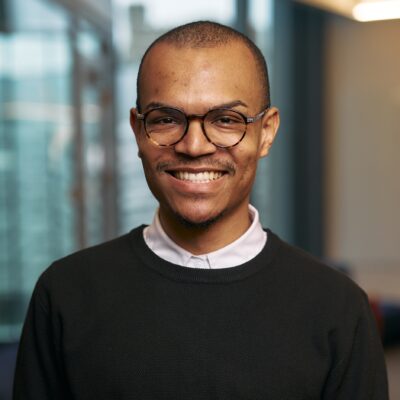
Jadon Geathers is a doctoral student in information science from Corning, New York. He earned his B.S. in mathematics and M.S. in computer science at Stanford University and now studies the development of AI conversation partners that aid effective language learning under the guidance of Rene Kizilcec at Cornell.
What is your area of research and why is it important?
My research focuses on developing AI conversation partners that help people learn languages more effectively. I build educational technology that adapts to each student, giving them feedback that fits their specific level. This is important because it bridges the gap between classroom theory and real-world practice. It provides a safe environment where learners can build confidence through repetition, making language education more enjoyable and accessible for everyone.
What are the larger implications of this research?
Language can be viewed as the primary bridge to human connection. When barriers exist, individuals face social isolation and a lack of belonging, regardless of their technical skills. My research impacts society by dismantling the “anxiety barrier” that prevents people from speaking. By creating safe spaces for authentic practice, we aid learners in building meaningful relationships and navigating their communities with confidence. This social integration naturally cascades into broader opportunities, allowing individuals to participate fully in society, whether culturally, personally, or economically.
Can you tell us about ChitterChatter?
ChitterChatter is an AI-powered conversational platform designed to facilitate authentic speaking practice for language learners. The system enables educators to craft customized conversational scenarios that align directly with their specific curriculum. Students then engage with these cases in a low-stakes environment, allowing them to practice speaking without the social anxiety of face-to-face interaction. Following these sessions, the platform provides high-quality, adaptive feedback, helping learners refine their skills and build confidence before applying what they’ve learned in the real world.
What role do you see AI playing in the future of learning?
I see the future of AI in learning as a means of complementing teaching practice and democratizing personalized tutoring. One of the most effective ways to learn, regardless of domain, is through one-on-one coaching with immediate, personalized feedback, which has been traditionally difficult to scale. In the future, I believe students will use AI to learn in an environment that provides the safety to fail and the scaffolding to improve, freeing up human educators to focus on mentorship, connection, and more complex instruction.
What are your hobbies or interests outside of your research or scholarship?
I try to keep a balance between creative and active pursuits. I play both the piano and saxophone, and I love watercolor painting. To stay active, I enjoy rock climbing and volleyball. I also love playing chess, and fittingly for my research, I am currently studying Mandarin.
Why did you choose Cornell to pursue your degree?
I was drawn to the deeply interdisciplinary and diverse nature of the field of information science. My work requires a mix of technical building and human-centered design, and Cornell provides the perfect home for that. The community support and resources here have been indispensable in helping me grow both as a scholar and a developer.