
Student Spotlight: Leonardo Santamaria Montero
March 30, 2026
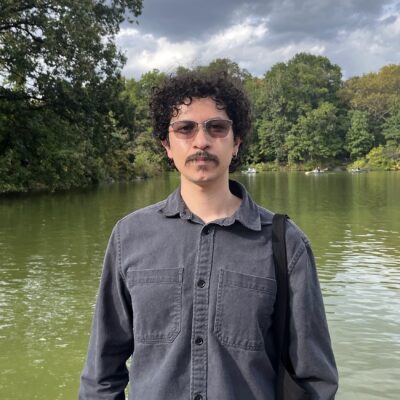
Leonardo Santamaria Montero is a doctoral candidate in the history of art, archaeology, and visual studies from San José, Costa Rica. He earned his bachelor’s degree at the University of Costa Rica and now studies visual and material culture of 19th-century Central America under the guidance of Ananda Cohen-Aponte at Cornell.
What is your area of research and why is it important?
I am specializing in Latin American art with a dissertation on visual and material culture of 19th-century Central America. I focus on the K’iche’ Communal Government of Totonicapán in the highlands of Guatemala, the Afro-Indigenous Mosquito Confederation on the Caribbean coast of Nicaragua, and the region of Talamanca ruled by the Bribri in southern Costa Rica as my primary case studies. My research challenges conventional interpretations by centering objects, traditions, and communities that have been historically marginalized. This approach offers a new perspective on Indigenous and Afro-Indigenous expressions of sovereignty and visual resistance during the 19th century.
What are the larger implications of this research?
The historiography of Latin American art often excludes the arts of Indigenous and Black communities, relying on narratives shaped by Spanish criollos and their descendants. This has produced a bibliography structured by colonial racial and geographic hierarchies that continue to shape power dynamics in Central America. My research challenges these frameworks by centering marginalized objects, traditions, and communities to tell alternate histories of Indigenous and Afro-Indigenous sovereignty and visual resistance. These stories remain largely unknown in Central America, and I believe my project has strong educational potential. I also hope my research will be useful to the communities.
What does it mean to you to have been selected for a Zhu Family Graduate Fellowship?
Being selected for the Zhu Family Graduate Fellowship is a privilege and a meaningful academic achievement. Receiving the fellowship is the result of years of hard work, and I feel proud. I am a first-generation student who was able to attend college thanks to my family’s support and scholarships from the University of Costa Rica. Receiving the Zhu Fellowship makes me especially thankful to all of them and to the Zhu Family. I understand the responsibility that comes with being a fellowship recipient, and that motivates me enormously to continue working on my dissertation and give my best.
What will this fellowship allow you to do that you might not have otherwise?
The Zhu Fellowship allows me to fully dedicate myself to work on my dissertation. Since it does not require residency in Ithaca, I moved to Philadelphia for its strategic location and access to museums and libraries relevant to my research, as well as major airports and the Amtrak rail system to travel internationally and go to key institutions in New York City and Washington, D.C. The fellowship also gives me greater scheduling flexibility to plan my research travels. This will allow me to visit Guatemala this fall to conduct my dissertation research, something I would otherwise be unable to do.
What are your hobbies or interests outside of your research or scholarship?
I enjoy walking around the city, the mountains, or the beach. I like traveling and discovering new places with my loved ones. I like going to the movies and hanging out with friends. I also really enjoy food, both cooking and eating. I enjoy going to concerts and cultural events in general. And, of course, I love visiting museums and art galleries in my free time, because it’s my passion. I also serve as a member of the Board of Directors of the Museum of Contemporary Art and Design of Costa Rica (MADC), representing the National Board of Curators.
Why did you choose Cornell to pursue your degree?
The graduate program in history of art, archaeology, and visual studies at Cornell University is characterized by its critical approach to artistic practices within their cultural context and was the perfect academic program to pursue my Ph.D., due to its interdisciplinary and critical approach to the history of the visual arts. My interest in working with Professor Ananda Cohen-Aponte, who has been an excellent advisor over the years, was also crucial in my application to Cornell. I was also interested in connecting with Cornell’s programs in American Indian and Indigenous studies and Latin American and Caribbean studies, which has greatly benefited my training and research.