
Student Spotlight: Nia Whitmal
March 30, 2026
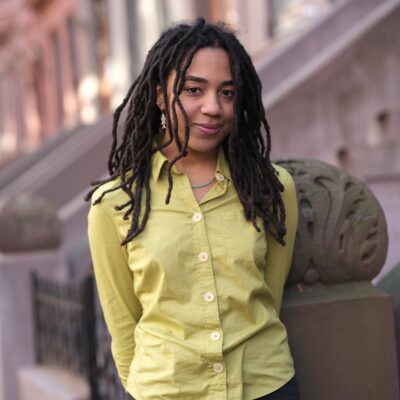
Nia Whitmal is a doctoral candidate in anthropology from Amherst, Massachusetts. She earned her bachelor’s degree from Yale University and now studies the wealth accumulation strategies of Harlem’s Black property-owners and real estate agents under the guidance of Chloe Ahmann at Cornell.
What is your area of research and why is it important?
I study the wealth accumulation strategies of Harlem’s Black property-owners and real estate agents and the way they conceive of ‘luck’ to explain their advantageous position in the neighborhood. I investigate the class dynamics within Harlem’s Black communities alongside the private developments that continually alter the landscape of the neighborhood, unmoor residents’ claims of belonging, and stoke tensions between newcomers and long-standing Harlemites. Alongside structured interviews and participant observation, I employ ethnographic filmmaking for nuanced depictions of an upwardly mobile Black elite, a largely underrepresented population in anthropological research.
What are the larger implications of this research?
Film yields a unique capacity to communicate social issues, structures of inequality, and know-how to diverse audiences through the interplay of sound and image. As my initial findings indicate, the real-estate know-how that primed certain Harlemites for homeownership is coveted and, at times, inaccessible information primarily circulated between between privileged actors. Through film, I hope to circulate this amalgam of know-how, history, and policy to address gaps in generational wealth-building and represent the histories of affordable housing structures in New York.
Furthermore, by foregrounding and filming Harlem’s Black elite, I aim to complicate entrenched understandings of Blackness as the lived realities of class, belonging, change, and race unfold before the camera.
What does it mean to you to have been selected for a Zhu Family Graduate Fellowship?
There is a dearth of large-scale funding for scholars in the humanities, let alone fellowships that reward interdisciplinary research in the humanities. My doctoral work is situated in anthropology yet pulls from Black studies, documentary production and exhibition, and urban studies. At times, I struggle to reconcile the separations between these disciplines. The Zhu Fellowship, however, provides critical encouragement and material support to refine the resonances between documentary, Blackness, and housing in Harlem. The Zhu Fellowship is a directive to continue to fashion connections between seemingly disparate modes of inquiry.
What will this fellowship allow you to do that you might not have otherwise?
As a Zhu Fellow, I have the ability to zero in on my research in a city as cost-prohibitive as New York. I recently moved across the street from the Schomburg Center for Research in Black Culture in central Harlem. With the funding afforded by the Zhu Fellowship, I can spend time in their archives, supplementing my work on west and central Harlem’s contemporary housing landscape with historical records. I may also lean into more protracted research processes, such as interview transcription and analysis, to tease out emergent themes from my fieldwork. Without support from the Zhu Fellowship, I would otherwise struggle to devote as much time to such critical aspects of my research.
What are your hobbies or interests outside of your research or scholarship?
When I’m not doing research, I work in programming and archives at the Maysles Documentary Center and intern at Florentine Films. When I have time, I love to work as a camera operator on documentary and narrative projects. On weekends, I like to see repertory films and shop vintage. I enjoy low-stakes baking, music, and spending as much time as possible with loved ones.
Why did you choose Cornell to pursue your degree?
When I applied to Cornell, I was drawn to the research interests of the faculty in the anthropology department. Chloe Ahmann’s focus on speculation in post-Industrial American cities, alongside Amiel Bizé’s writings on gleaning and indeterminate property were of great interest. I appreciated the department’s inclusion of visual anthropology and was thrilled to enroll in an ethnographic filmmaking course, taught by Natasha Raheja, in my first semester. That course, in addition to the fall 2021 Mellon-funded urban justice seminar co-taught by Riché Richardson and Peter Robinson, brought me to New York, camera in-hand, and introduced me to homeowners and preservationists in Harlem, whom I filmed, and helped laid the groundwork for my doctoral studies. It is this combination of working with deeply passionate, unique scholars and enrolling in dynamic, well-resourced coursework that drew me to Cornell.