
Student Spotlight: Tobias Weinberg
May 11, 2026
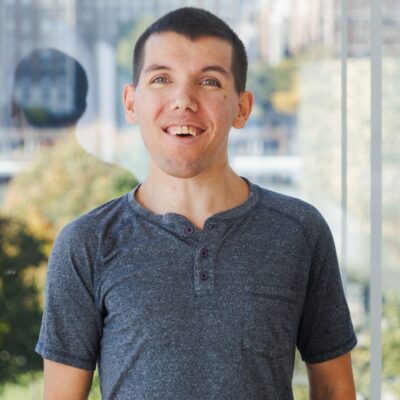
Tobias Weinberg is a doctoral candidate in computer science from Buenos Aires, Argentina. He earned his bachelor’s degree at the Technion Israel Institute of Technology and now studies the reframing of augmentative and alternative communication technology as a medium of expression under the guidance of Thijs Roumen at Cornell.
What is your area of research and why is it important?
Many people communicate using augmentative and alternative communication (AAC) technology like speech-generating apps that help people who cannot rely on spoken voice. Most AAC systems treat communication as a transaction: Get a message across, efficiently. But communication is so much more than that. My research reframes AAC technology as a medium of expression instead of a workaround for missing speech, developing AI-powered systems that move beyond transactional speech to support expressive participation in conversation. I design and study AAC technologies that adapt fluidly to users’ agency, identity, and privacy needs, enabling overlooked forms of expression.
What are the larger implications of this research?
AAC affects hundreds of thousands of people worldwide, yet most systems are designed around a narrow idea of what communication is “for.” My work challenges that assumption, with implications for how AI is built into assistive technology: Whose voice does it reflect? Whose culture, humor, and conversational style? As AI becomes increasingly embedded in communication tools, getting these questions right matters enormously, not just for AAC users, but for anyone whose identity is at risk of being flattened by a generic AI, one-size-fits-all system. This research is ultimately about who gets to show up fully in conversation and who doesn’t.
What does it mean to you to have been selected as a 2026 Apple Scholar in AIML?
Being selected as an Apple Scholar is genuinely meaningful to me on multiple levels. AAC is a field that often sits at the margins of AI research, important to the people it affects, but underrepresented in the conversations shaping where AI goes next. This recognition signals that the questions I’m asking about identity, agency, and expression belong in that conversation. As an AAC user myself doing this work, it also feels like a kind of validation that the autoethnographic, deeply personal approach I’ve taken is worth taking seriously alongside more conventional research paradigms.
What will this scholarship allow you to do that you might not have been able to otherwise?
This scholarship allows me to build the next generation of AAC technology, systems that don’t just help people get words out, but that adapt to who they are: their humor, their culture, their communication style. Specifically, it funds the deep, ongoing work with AAC users that this kind of research demands — building tools with people, not just for them, and following their experiences over time. Apple’s support also connects me to engineers who share this mission, creating a rare bridge between what research discovers and what technology actually delivers to people who need it.
What are your hobbies or interests outside of your research or scholarship?
I’m a musician. When I’m not doing research you would find me behind a drum kit or playing bass in some bar in New York City. I recently built my own bass by hand, CNC-machining a body from purpleheart wood fitted with vintage Fender components. The making process scratches the same itch as research: iterative, detail-obsessed problem-solving with something tangible at the end. Music keeps me grounded; there’s something clarifying about communicating entirely without words which is perhaps ironic for someone who spends his days rethinking how people communicate.
Why did you choose Cornell to pursue your degree?
Cornell Tech’s position at the intersection of technology and real-world impact made it the right fit for research that refuses to stay purely theoretical. More specifically, I chose Cornell to work with Thijs Roumen, whose approach to HCI takes craft and materiality seriously in ways that shaped how I think about building for and with people.