
Collective Power from the 1980s to Now
November 16, 2026
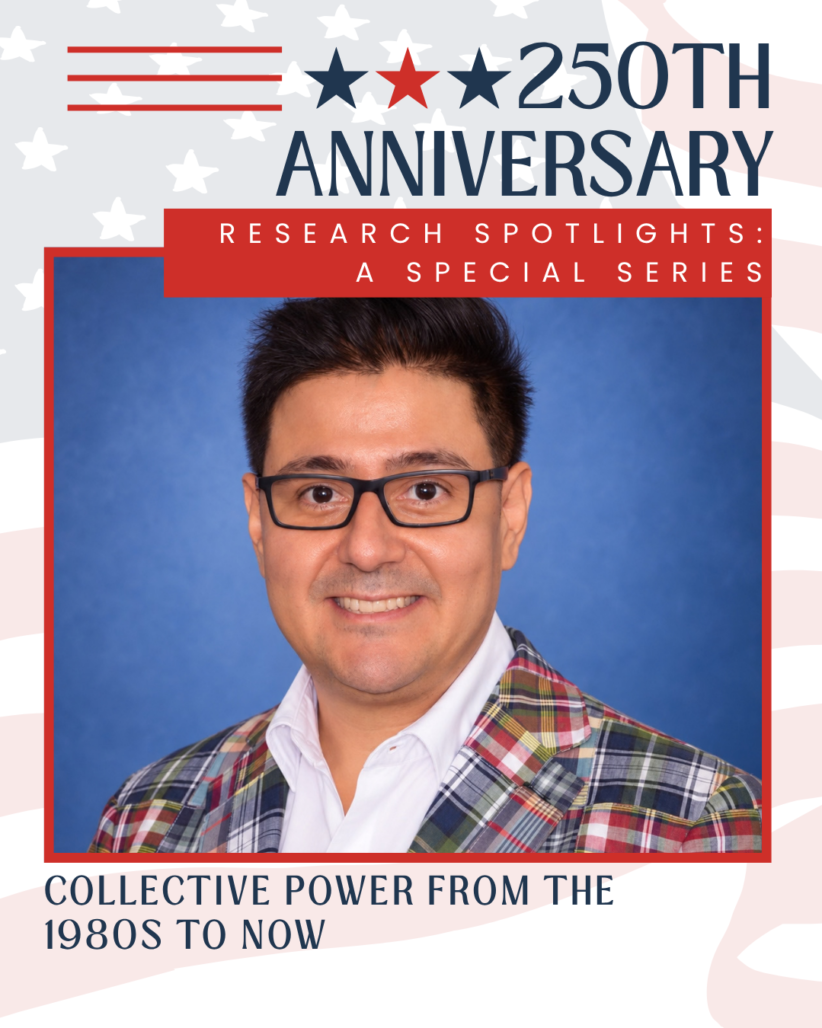
Adolfho Romero, a M.S./Ph.D. student in industrial and labor relations, shares his research as part of a special spotlight series celebrating the United States’ 250th anniversary. In this series, we’re inviting current graduate students and alumni to share how their research explores the past, interrogates the present, and helps us imagine the next 250 years of life in America to engage with this important milestone.
In a couple of sentences, what is the focus of your research?
I study how workers build, lose, and rebuild collective power through unions, worker centers, and community organizations, particularly in small cities and rural communities. Drawing on archives, labor newspapers, and oral histories, my current research traces labor organizing in Tompkins County from the 1980s to the present, examining how organizing knowledge, relationships, and civic traditions such as the annual Labor Day picnic have endured through deindustrialization and the transition from manufacturing to an economy centered on service work and large educational institutions.
What inspired you to pursue this area of research, and why does it matter today?
My interest began with my working-class Mexican and Salvadoran family in Humboldt Park, Chicago. My mother worked in factories and spoke up about unsafe conditions and the unfair treatment of her coworkers. Her example taught me that solidarity begins when people recognize a shared problem and decide to stand up for one another. Later, my work with farmworker communities in Florida and labor coalitions, as well as serving as assistant director of the Samuel Proctor Oral History Program at the University of Florida, deepened my interest in how communities build collective confidence, protect their voices, and preserve the full complexity of their histories.
This research matters because many low-wage, immigrant, undocumented, and guest workers face significant barriers to exercising rights that may exist on paper. Studying how organizing capacity is built and preserved locally helps us understand what community-based action can accomplish and what protections are lost when unions and other institutions at the federal or state level decline including the National Labor Relations Board.
What is one common assumption about your topic that your research challenges or complicates?
A common assumption is that when a unionized factory closes, its influence closes with it. In the 1980s, a regional labor coalition (Tompkins Cortland Labor Coalition) of more than 40 unions represented over 10,000 workers across Tompkins and Cortland counties. As employers such as the Ithaca Gun factory, the Smith Corona plant, and the Cargill salt mine cut or eliminated union jobs in the years that followed, that coalition’s formal power shrank. But my research shows that unions leave behind political and cultural infrastructure: relationships, practical knowledge, shared traditions, archives, and community worker centers. That infrastructure can resurface in a new organization years later, carried forward by the same organizers, long after the original union and even the workplace itself are gone.
How does your research illuminate the experiences of people or communities whose stories are often overlooked?
Labor history often centers major industrial cities, prominent strikes, and nationally recognized unions. Tompkins County is commonly understood primarily as a university community, others consider it a company town, but its history also includes factory workers, low-wage service workers, immigrant workers, and local organizers responding to plant closures and economic restructuring.
Through oral histories and local records, I examine these workers not simply as people affected by economic change, but as creators of institutions, strategies, traditions, and public policy. This perspective also foregrounds people who are frequently excluded from traditional labor narratives, including undocumented workers and formerly incarcerated people navigating reentry. Their experiences show that organizing also happens through worker centers, community coalitions, local publications, public meetings, and campaigns that rarely enter national accounts of American labor history.
How does your work contribute to conversations about democracy, citizenship, belonging, or participation in society?
As the United States marks its 250th anniversary, my research reminds us that democracy is practiced not only at the ballot box. It is also practiced in workplaces, union halls, worker centers, community gatherings, and city council meetings—places where people learn to deliberate, build coalitions, challenge authority, and hold institutions accountable. Labor organizing can give people a public voice even when their occupation, income, or immigration status leaves them with little individual power. This history reminds us that American democracy depends not only on formal legal rights, but also on whether ordinary people have durable institutions through which they can exercise and enforce those rights and act together.
What is the most surprising discovery or insight you have encountered through your research?
The Workers’ Center did not simply preserve older practices. In 2006, it also established the first Living Wage Employer Certification Program. By providing certified businesses with a visible storefront emblem, the program gave community members a practical way to identify and support employers committed to paying a living wage. It transformed fair wages from a private employment matter into a shared standard of community responsibility.
Together, these examples changed how I understand continuity and innovation in labor movements. Communities do not always rebuild from nothing, nor do they have to wait for national institutions to act. Organizing knowledge often survives through people and relationships, and that inherited knowledge can become the foundation for new forms of local accountability and collective power. Oral history helps recover these connections between what survives, what changes, and what communities create next.