
Graduate Students Demystify Research
November 2, 2026
By Katya Hrichak
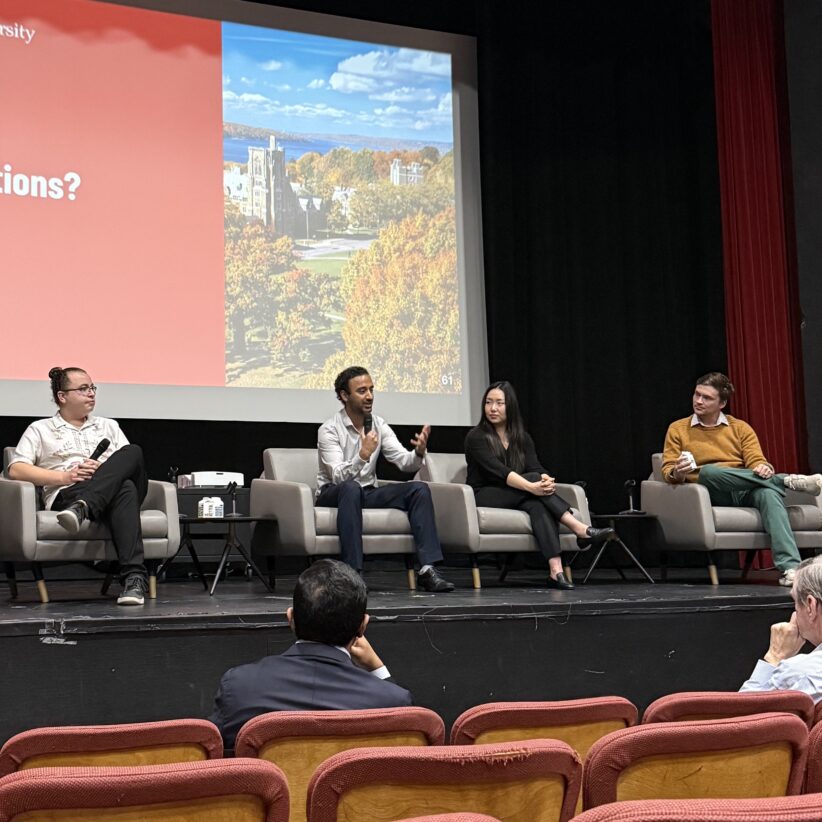
Five graduate students rose to the challenge of explaining their research in just five minutes at Research Lightning Talks: Big Ideas Demystified during the inaugural Cornell Volunteer Summit on Oct. 16.
Inspired by the Three Minute Thesis (3MT) competition, the session invited students to share what they’re working on with volunteers and alumni in attendance. In addition to having two extra minutes, presenters were able to use multiple slides and animations to convey their complex topics.
“We wanted to showcase graduate students because they’re essential to Cornell’s research mission,” said Ilana Dimbleby, director of engagement initiatives and college/unit partnerships in Alumni Affairs and Development and one of the event’s organizers. “Illustrating the breadth of disciplines and discoveries for alumni deepens their understanding of the student experience at all levels.”
Sharing the stage were Sahil Venkatesan, juris doctor of law student; Subash Bhandari, biomedical engineering doctoral candidate (and second place winner of Cornell’s 2026 3MT); Joy Yuri Kim, nutrition doctoral candidate; Zander Lynch, linguistics doctoral candidate; and David Tompkins, psychological sciences and human development doctoral candidate.
“It’s a great way to practice sharing our ideas, practice teaching them, and remember that we are not just here to solve funny little puzzles, but we’re actually here to improve knowledge more generally,” said Lynch of the decision to participate.
Kim noted that sharing research helps others become more interested in the given topics, but continued exposure can lead to more advocacy and funding, which can in turn further research progress.
In addition to practicing communication for a broader audience, Tompkins noted that his participation was also a way of giving back.
“Cornell has given me a lot of opportunities, and so when there’s an opportunity to give back to Cornell, I’m taking advantage of it,” he said.
With the exception of Venkatesan, who had to return to the Law School in preparation for providing legal aid to a client, the students came together for a Q&A following the conclusion of individual talks, during which an engaged audience inquired more deeply about their respective research.
“One of the reasons I came to Cornell was because it was a broad-based institution, and events like this just reaffirm it,” said Lindsay Forness ’84, who attended the session. “Learning is lifelong, and I wouldn’t find some of these topics if I was on my own.”
David Steward ’79 was similarly interested in learning about what sorts of directions researchers are taking at the university today.
“I was very pleasantly surprised that the students were really able to talk in plain English about their work,” he said, initially concerned that the talks would contain too much jargon for a general audience. “Their ability to talk to someone not in their academic track to me is a really important ability, and it was great to see that on display.”
Dimbleby agreed: “It is so valuable for alumni not only to learn about the research, but also to see how Cornell graduate students can communicate complex topics in easy to understand and engaging ways.”
Students interested in participating in a similar opportunity can watch the Graduate School’s News and Events newsletter for forthcoming information about the 2027 3MT competition.