
Political Polarization and the Attention Economy in Digital Media
October 5, 2026
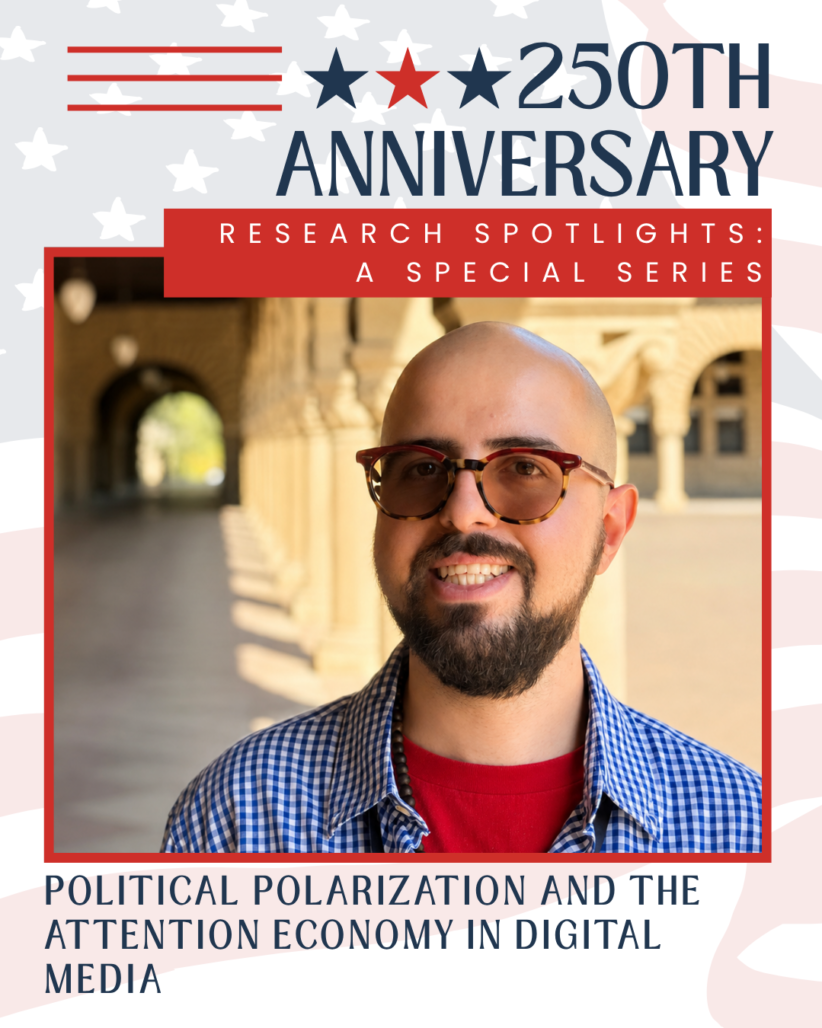
Mohammad Mosaffa, a doctoral student in management, shares his research as part of a special spotlight series celebrating the United States’ 250th anniversary. In this series, we’re inviting current graduate students and alumni to share how their research explores the past, interrogates the present, and helps us imagine the next 250 years of life in America to engage with this important milestone.
In a couple of sentences, what is the focus of your research?
I am a Ph.D. student in quantitative marketing at Cornell University’s S.C. Johnson College of Business, based at Cornell Tech, where I study how digital information environments shape what people see, what captures their attention, and how they respond. One strand of my research examines political polarization and the attention economy in digital media, including how U.S. news outlets visually portray political figures and shape what audiences see, as well as how political content is structured to capture and sustain people’s attention. Another strand examines how platforms use people’s personal data to personalize their digital experiences, and the tradeoff between the benefits of that personalization and the resulting costs to privacy.
What inspired you to pursue this area of research, and why does it matter today?
What inspired me to pursue this research is how much the information environment has changed in recent years. Digital platforms increasingly compete for people’s attention, and algorithms use growing amounts of personal data to determine what information and content different people see. These changes can also contribute to greater polarization, especially in political discourse. Advances in artificial intelligence are adding another layer to this shift by changing how information can be created, presented, and personalized. I became interested in understanding these forces more systematically, how media shape political portrayals, what kinds of content capture and sustain attention, and how much personalization benefits people relative to the privacy it requires. These questions matter today because the systems that organize our information increasingly shape how we understand politics, engage with digital platforms, and experience the world around us.
How does your work contribute to conversations about democracy, citizenship, belonging, or participation in society?
My research contributes to conversations about democracy by examining a part of political communication that is often overlooked. When we think about partisan news coverage, we usually focus on what an outlet says, the language of an article, its headline, or the issues it chooses to emphasize. But alongside that news, outlets also choose which images to show. For example, the same story about a political figure can be paired with an image that casts them in a more favorable or unfavorable light, without saying so explicitly. Because visual impressions can be formed quickly and with less conscious scrutiny than written arguments, they create a subtle but potentially important dimension of political polarization. One strand of my research combines machine learning and generative AI to measure these visual differences across U.S. news outlets and over time. I also study what kinds of political content capture and sustain people’s attention, and whether those patterns are associated with more polarizing discourse. Taken together, these lines of research help uncover less visible ways the media environment can shape political perceptions and public debate.
What does your research reveal about change over time in the United States, whether social, cultural, political, environmental, or technological?
A key finding from my research is that political polarization in the U.S. media environment is not static; it has become increasingly pronounced over time. By analyzing political coverage from leading U.S. news outlets from 2011 to 2022, we find a clear partisan pattern in visual portrayals: left-leaning outlets tend to portray Democratic politicians more favorably and Republican politicians less favorably, while right-leaning outlets exhibit the opposite pattern. More importantly, the gap between these opposing portrayals grows over time. This suggests that as political division in the United States has intensified, the media environment surrounding that division has also become more polarized. For the American public, I think an important takeaway is that media literacy needs to extend beyond evaluating headlines and written claims. As images become an increasingly prominent part of how we consume and interpret news, understanding media bias and promoting transparency also requires paying attention to the visual choices that accompany and shape the stories we see.
What is one common assumption about your topic that your research challenges or complicates?
As more of our everyday lives move online, digital platforms increasingly compete for users by personalizing the content and experiences they provide. To do so, they collect and track large amounts of information about their users. Behind this, there is a common assumption: the more data a platform has about a person, the better it can personalize their experience. My research examines how far that assumption actually holds by studying the privacy-utility tradeoff associated with different types of personal information. In one strand of my research, we compare people’s behavioral data, their “digital footprint” with location data, their “physical footprint” in ad personalization. We find that location data is especially useful when little is known about a person but becomes less valuable as more is learned from their behavior. Importantly, from the users’ perspective, our findings show that they can opt out of location tracking once enough behavioral information is available while still receiving similarly relevant personalization. From a regulatory perspective, the results also provide a basis for stricter limits on continued collection of sensitive location data when it offers little additional value.
What challenges or opportunities do you think your field will help address over the next 25, 50, or 250 years?
One of the important challenges for the coming decades is how artificial intelligence will reshape our information environment. Digital platforms already influence what we see and what captures our attention, while the rise of generative AI and large language models adds a new dimension: These systems can create, personalize, and adapt information for different individuals, rather than simply choosing among existing content. This creates opportunities for more useful and relevant digital experiences, but it also raises questions about attention, privacy, persuasion, and political discourse. My field can contribute by bridging economic theory with advances in machine learning to measure and study human behavior in these evolving digital environments. Looking toward the next 25, 50, or even 250 years, an important question will be not simply how capable these technologies become, but how we can build AI-driven information systems that are fair, transparent, accountable, and designed to serve people and society.