
The Effect of Federal Policy on Tribal Nations
October 19, 2026
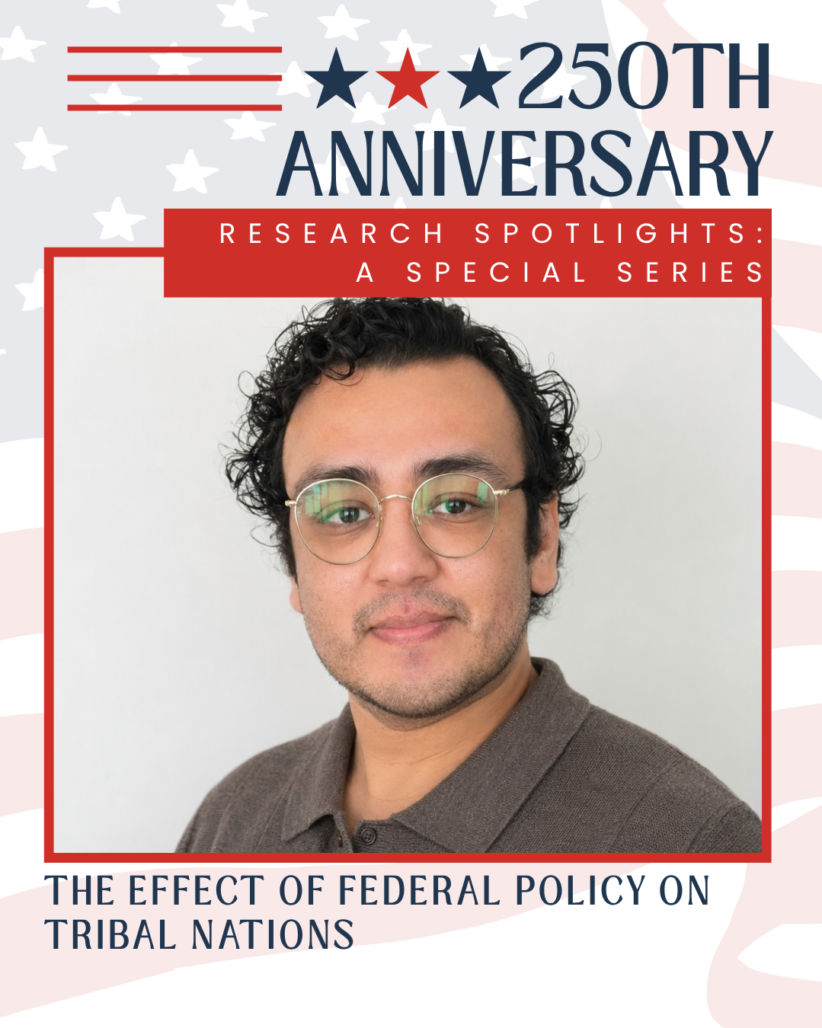
Elijah Moreno, a doctoral candidate in public policy, shares his research as part of a special spotlight series celebrating the United States’ 250th anniversary. In this series, we’re inviting current graduate students and alumni to share how their research explores the past, interrogates the present, and helps us imagine the next 250 years of life in America to engage with this important milestone.
In a couple of sentences, what is the focus of your research?
My research examines how federal policy shapes the political and economic life of tribal nations and Native communities. Across projects on tribal termination, COVID-19 vaccination, and the restoration of tribal land, I study what happens when the federal government withdraws recognition, how histories of coercion affect trust in institutions, and what changes when tribes regain land and governing authority. Although this work centers tribal nations, it addresses questions in policy and public economics: What makes government legitimate? How do institutions earn or lose trust? How does recognition affect a community’s capacity to govern, develop, and endure? By tracing outcomes to policy decisions, I aim to replace narratives of unexplained disadvantage with evidence about the institutions that produced it. Ultimately, my research asks how public policy determines which communities are empowered to shape their futures, which are constrained by decisions made elsewhere, and what becomes possible when political authority is restored.
What inspired you to pursue this area of research, and why does it matter today?
My first job in Indian Country was as a Wilma Mankiller Fellow at the National Congress of American Indians. At an NCAI conference, I heard Secretary of the Interior Sally Jewell say, “If you’re not at the table, you’re on the menu.” I came to understand that as being about more than representation. It is about who sets the agenda, whose communities are visible, what evidence counts, and which policies are considered possible. I come to this work personally. I am an enrolled member of the Coastal Band of the Chumash Nation, which is not federally recognized. That experience gives me a vantage point on recognition and legitimacy. Tribal nations are not merely seeking a seat at an American table built without them. In many respects, they helped build the table itself. How the United States treats them reveals its commitments to sovereignty, legitimacy, the rule of law, and history.
How does your research help us understand the origins and history of the United States and how we came to be where we are today?
You cannot explain the origins of the United States by placing tribal nations at the margins of its history. Tribes are woven into the Constitution, federalism, territorial expansion, and the development of federal power. The country’s growth depended not only on acquiring Indigenous land, but also on repeatedly redefining the legal and political status of the people who already governed it. My research shows that policy can become a weapon. Removal, allotment, boarding schools, the destruction of tribal economies, and termination were carried out through legislation, administrative systems, and other ordinary instruments of government, often with legal backing. Many contemporary disparities are not detached from history. They are downstream of deliberate interventions into land, jurisdiction, family life, political recognition, and governing authority. Studying those connections reminds us that legality and justice are not synonymous: Formally lawful institutions can still deprive communities of the resources and relationships they need to endure.
What is one common assumption about your topic that your research challenges or complicates?
One assumption my research challenges is that there is a single tribal experience or one policy model that can be applied across Native communities. The Indigenous landscape includes pueblos, rancherías, federally and state-recognized tribes, nonfederally recognized tribes, Alaska Native villages and corporations, and Native Hawaiian communities and organizations. Their histories, land arrangements, governments, legal statuses, and relationships with other governments differ substantially. That variation is not statistical noise to be discarded. It often explains why the same policy produces different outcomes in different places. I therefore try to include the broadest defensible set of communities and ask where an effect holds, where it does not, and what that variation reveals. This approach exposes limitations in conventional data and methods, which were rarely designed for small communities with unusual political boundaries or incomplete records. Methodological inconvenience does not make those communities unimportant. It requires greater care, clearer definitions, and honest uncertainty.
How does your research illuminate the experiences of people or communities whose stories are often overlooked?
One consequential form of invisibility is appearing in research only as an outcome: a poverty rate, health disparity, or population considered too small to analyze. Native communities are often missing from datasets, classified inconsistently, or absorbed into geographic units. Those choices shape which disparities become visible and which remain outside the policy agenda. My work treats these limitations as problems to solve rather than reasons to look elsewhere. I reconstruct histories of recognition, termination, land loss, restoration, and other government interventions across as many tribes as evidence permits. This changes the story. Tribes are not simply populations experiencing disadvantage, they are governments rebuilding institutions, protecting communities, and pursuing development while confronting constraints accumulated over generations. Their achievements become more significant, not less, once we understand those conditions. When Native communities are represented in data used for decisions, they are better positioned to demonstrate needs, evaluate policies, and hold institutions accountable.
What does your research reveal about change over time in the United States, and how does your work contribute to conversations about democracy, citizenship, belonging, or participation in society?
My work asks a question that precedes discussions of democracy: Who is recognized as a political people with the authority to govern? Federal recognition carries legal and material consequences, but recognition and belonging are not identical. A community may be historically and politically real to its people while remaining unrecognized by the federal government. The United States can confer or withhold legal recognition, but it does not have a monopoly on belonging or legitimacy. Tribal nations are not merely constituencies seeking representation within institutions; they are governments with citizens and authority to make decisions. Over time, federal Indian policy has moved between recognizing tribal political authority and attempting to eliminate, absorb, or constrain it. That history shows that democratic inclusion is neither automatic nor irreversible. Understanding these overlapping forms of citizenship, recognition, belonging, and legitimacy is essential to understanding tribal sovereignty and the unfinished work of American democracy.