
The U.S. Regulatory System and the Public
November 2, 2026
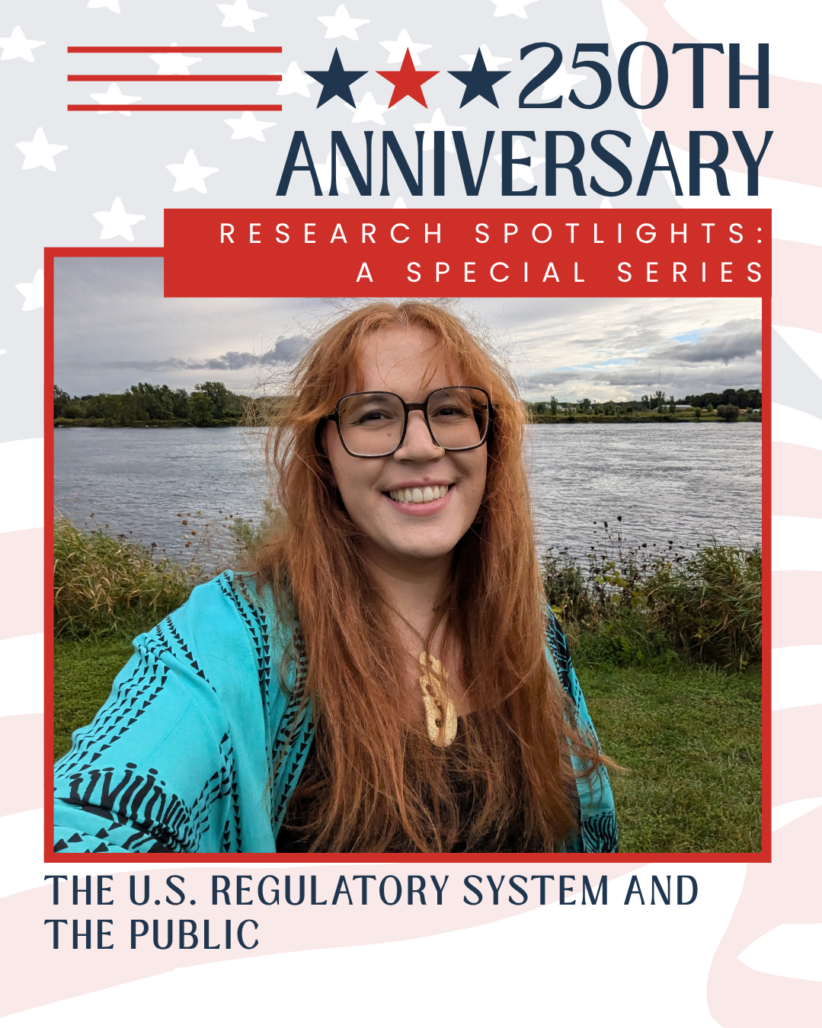
Aspen Omapang, Ph.D. ’26, an information science doctoral graduate, shares her research as part of a special spotlight series celebrating the United States’ 250th anniversary. In this series, we’re inviting current graduate students and alumni to share how their research explores the past, interrogates the present, and helps us imagine the next 250 years of life in America to engage with this important milestone.
In a couple of sentences, what is the focus of your research?
The efficacy of our voice in U.S. political systems can feel shaky even at the best of times. My research studies the U.S. regulatory system at the federal and state-level, specifically focusing on public comment submission and testimony concerning the environment. This involves data analysis of federal agencies over a 25 year period resulting in millions of public comment submissions. This work is in tandem with on-the-ground interviews in Hawaiʻi with Native Hawaiian advocates and traditional knowledge practitioners.
What inspired you to pursue this area of research, and why does it matter today?
I am a descendant of Hawaiʻi Island. My mother’s side emigrated to Hawaiʻi island as Filipino agricultural migrants in the late 1800s—during the forced annexation by the U.S.—and we have been there ever since. This generational relationship to land creates kuleana, a responsibility to the land’s health and perpetuation. The state of Hawaii’s constitution looks unlike any other in the U.S. as it affords specific rights and responsibilities not only to Native Hawaiians, but to the natural resources of Hawaiʻi. As hoaʻāina, servants of place, we have identified regulatory policy as the most effective way to restore ecological systems that are key determinants of our health and the health of generations to come.
Perhaps the easiest task today is to find the “doom.” We are overwhelmed with information and firsthand accounts of the worst we have to offer, while simultaneously feeling our ability to do anything about it has rapidly chipped away. The years of reconnection back home have taught me that hope and happiness are found beneath our feet and within arms’ reach. It is holding both truths: that we are winning and that we have suffered profound, generational losses. This type of research shows that what the U.S. fears the most is mutual aid-driven and self-sustaining communities. It is through compromise and difference grounded in our commitment to our place that allows for joy to be held hand-in-hand with grief. This is a way to find hope in the unending unprecedented moments of today.
How does your research help us understand the origins and history of the United States and how we came to be where we are presently?
In 1893, only 132 years ago, the Hawaiian monarchy was overthrown by the U.S. federal government. Six decades later, the territory of Hawaiʻi became a state. The origins of the United States is a story of forcible, illegal dispossession and attempted genocide—one that is very much in living memory back home. By studying Native Hawaiian case law and the the Hawaii state constitution, we can find veins of knowledge about the U.S. political system. The political system that emerges is a representative democracy that systematically reduces and silences the voice of its people. We are feeling the continued degradation of our rights, protections, and regulations in the wake of the current administration.
What can be learned from my work is about community-building, the power of local government, and generational commitment. My community is the story of traditional ecological knowledge being a part of U.S. regulation: a kihoʻihoʻi, a revitalization of socioecological systems. Our story is shared with Cornell’s first graduate student union, nodes of resistance to Immigration and Customs Enforcement across the U.S., and the national pushback against surveillance tech like Flock and data centers writ large, among others. My research shows that this country was born and raised to erase and eliminate, but we show that our successes exist and have always come from each other.
What is one common assumption about your topic that your research challenges or complicates?
I recall visiting a state park along the west Hawaiʻi coast, in which a small boy on vacation said, “Is this all this island is? Just rocks?!” Hawaiʻi may be the most remote place in the entire world, but you will be hard-pressed to find someone who hasn’t heard of, or vacationed, there. At one time Hawaiʻi was an agricultural export capital and now it is well into an established tourism economy—my great-grandmother worked at the first hotel on Hawai’i island.
One major misconception about my work is that there is a dichotomy: There are Hawaiians and locals that want tourism for economic reasons and those that wholly resist, leaving self-aware tourists in a bind. This is contrasted in the public advocacy work I do, in which there is strong collaboration across environmental nonprofits, Native Hawaiian-led organizations, governmental organizations, grassroots and community leaders, and locals. We do not seek the elimination of regulatory systems; instead we steer them back to serving the natural resource and socioecological systems our ancestors documented and upheld. In turn, my community’s philosophy has been to educate and direct tourism, rather than avoid or resist tourism outright. Our traditional governance and culture hold ʻāina—our reciprocal socioecological relationship—above all. What I have learned from my teachers is that in policy and relationships, we seek to bring people into these systems so that they may feel their effects and learn the practices to mālama—care for them too.
What does your research reveal about change over time in the United States, whether social, cultural, political, environmental, or technological?
Americans have grown immensely in their understanding and articulation of environmental issues. In my work, I look at decades of public input on proposed environmental regulation and track the changes over time in the word choice and topics that Americans use. Environmentalism had a fairly narrow scope and definition as recent as the early 2000s and, over a 25 year period, has not only evolved in complexity—including the citation of scientific studies, synthesizing of data, and firsthand practitioner accounts—but in how connections across other social movements are identified. Environmentalism is generally seen now as directly connected to specific social issues and social movements. In the last half decade, Americans are even advocating for Indigenous knowledge and strategic partnerships with tribes and communities to inform environmental regulation. There is a level of consciousness that is taking hold which needs to be cultivated in order to center the sovereign status of Native Nations in this advocacy.
If you could share one takeaway from your research with the American public, what would it be and why?
The public wins. For Indigenous peoples, I hope my work sheds light on how we in Hawaiʻi have found success in developing policy and regulation to help bring our land, sea, and air back into balance. How we have used the citizenship that was forced upon us to bring our ways of knowing into regulation and policy. And that we see this as a direct stepping stone on our path to self-determination, self-governance, and, ultimately, sovereignty. For Americans, I know that having belief in the current political system can feel impossible in this moment. However, our wins, the public’s wins, are happening. Embrace the community, embrace the fight. If you want a more equal, a better America, then show up. Setup a food share program with your neighbors, offer your car once a week to ferry elders to their appointments, teach a free class through your local library, and receive as much as you give. The bonds we make insulate us from politicization and make sure our fight lasts through our lifetimes and across generations. I see as much preparation for the testimony as I do cookouts and karaoke, and this is how, in our small ways, we get through.