
Two Doctoral Students Selected as FFAR Fellows
June 29, 2026
By Katya Hrichak
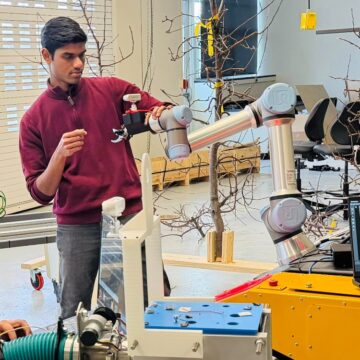
Divyanth Loganathan Girija (L.G.), a doctoral student in biological and environmental engineering, and Sumit Sharma, a doctoral student in animal science, were selected for the 2026-2029 Foundation for Food and Agriculture Research (FFAR) Fellows Program.
Created by the College of Agriculture and Life Sciences at North Carolina State University and the Foundation for Food and Agriculture Research, the program provides professional development and career guidance across FFAR’s challenge areas and strategic initiatives to the next generation of food and agriculture scientists.
“Being selected for the FFAR Fellows Program is both an honor and an important milestone in my professional journey,” said L.G. “It represents recognition of the importance and potential impact of my research on agricultural automation.”
Sharma described his selection similarly, as both an honor and a source of encouragement.
“Coming from a veterinary background and growing up in Nepal, I have seen firsthand how important practical, science-based solutions can be for farmers. The fellowship recognizes not only my research but also the potential impact that this work can have on agriculture,” he said. “The opportunity motivates me to continue pursuing research that bridges scientific innovation and real-world application.
At Cornell, L.G.’s research focuses on integrating robotics, artificial intelligence, and advanced sensing technologies into farming operations with the goal of developing more sustainable, resilient, and efficient agricultural systems. He will receive mentoring over the next three years from university and industry representatives as a FFAR Fellow and looks forward to the opportunity to bridge the gap between the two, starting with an upcoming co-op with Bayer Crop Science.
“The program’s mentoring structure is particularly valuable for my career goals,” he said. “Learning from industry scientists and leaders through the FFAR network would provide perspective on how research innovations progress from laboratory prototypes to field-scale agricultural technologies.”
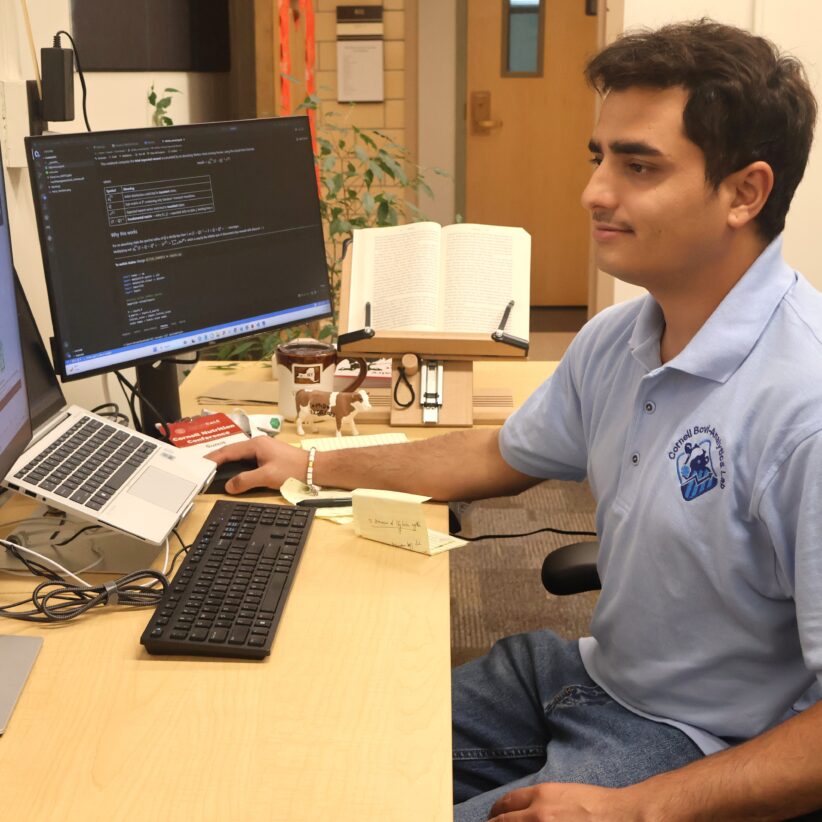
For Sharma, whose research focuses on developing mathematical and computational tools that help dairy farmers make quicker and better-informed decisions, the mentorship and networking opportunities with individuals from academia, industry, and nonprofits will be valuable.
“Because my research sits at the intersection of animal science and artificial intelligence, learning from experts with different perspectives will help me think more broadly about how research can be translated into tools that producers can actually use,” he said.
In addition to learning from mentors, they will also be able to engage with and learn from peers during a mix of virtual and in-person professional development training sessions.
“The program provides an opportunity to join a community of emerging leaders who are committed to solving critical challenges in food and agriculture. I value the interdisciplinary nature of the program because advancing agricultural technologies requires collaboration among engineers, plant scientists, breeders, policymakers, and industry leaders,” L.G. said.
Sharma said, “The cohort structure and the program’s Washington, D.C. sessions on science policy are also opportunities I would not have had otherwise, and both matter for the kind of career I want to build.”
Since the program’s creation, 200 fellows from 45 universities across the U.S. and Canada have participated in eight cohorts.