
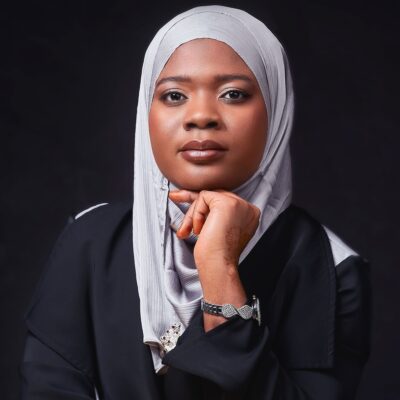
Student Spotlight: Aminat Ibrahim
September 14, 2026
Aminat Ibrahim is a doctoral candidate in biomedical engineering from Ilorin, Nigeria. She earned her bachelor’s degree at the University of Ilorin and now studies the improvement of cardiovascular implant compatibility under the guidance of Jonathan Butcher at Cornell.
What is your area of research and why is it important?
My research focuses on improving the compatibility of life-saving cardiovascular implants such as mechanical heart valves. For many patients with heart valve disease, including young adults and pregnant women, receiving a mechanical valve can mean depending on lifelong blood thinners to reduce the risk of dangerous blood clots. While effective, these medications can also introduce serious risks such as internal bleeding and lifestyle limitations. Many current valve designs were developed decades ago and were primarily optimized for durability. My research explores how to engineer the surface design of these valves to better support the body’s natural protective cell lining, which helps prevent clotting naturally. By designing surfaces that work more naturally with the body, my work aims to contribute to the development of safer, next-generation heart implants.
What are the larger implications of this research?
Cardiovascular diseases affect millions of people worldwide, and many life-saving implants still face challenges related to clotting and long-term compatibility. My research contributes to ongoing efforts to develop safer and more biologically compatible blood-contacting medical devices. One aspect of this work that is especially important to me is translation beyond the laboratory. I work with materials that are already widely used in medical devices and design experiments under clinically relevant conditions, so the findings can more realistically contribute to future implant technologies. The translational potential of this work has also supported early discussions around future commercial and clinical translation. More broadly, I hope this research helps demonstrate how engineering and biology can come together to improve the safety and long-term performance of medical implants that interact directly with blood.
You were named People’s Choice Award winner in the 2026 Three Minute Thesis competition. Can you describe the process of condensing your research into a three-minute presentation?
Trying to condense five years of research into a three-minute presentation was incredibly difficult. A major challenge was learning how to simplify the science while still preserving the meaning and scientific depth behind the work. I realized that many of the words and explanations I naturally use every day in research settings do not always translate clearly to broader audiences. I went through several rounds of iteration, constantly refining how to explain my research in a way that was clear, relatable, and still grounded in the science. The experience deepened my appreciation for storytelling and translation in scientific communication. Winning the People’s Choice Award meant a great deal to me because it reinforced something I care deeply about: the power of science to connect with people and create impact beyond the laboratory.
How will you take what you’ve learned from participating in the 3MT and use it in future academic and professional contexts?
Participating in the 3MT reinforced for me that scientific communication is just as important as scientific discovery. As researchers, we often work deeply within technical spaces, but meaningful impact depends on our ability to communicate clearly across disciplines and to broader communities beyond academia. The experience strengthened my ability to explain complex ideas in an accessible and engaging way while staying grounded in the science. It also deepened my interest in science communication and advocacy, especially in helping bridge conversations between research, health care, policy, and the public. Moving forward, I hope to continue building at the intersection of research, communication, and real-world impact through interdisciplinary collaboration, mentorship, public engagement, and the translation of biomedical technologies beyond the laboratory.
What are your hobbies or interests outside of your research or scholarship?
Outside of research, I am deeply impact-driven and enjoy leading organizations and initiatives that support and empower people across different communities. During my time at Cornell, I have been involved in student leadership, mentorship, outreach, and advocacy efforts focused on student support and community building. I care strongly about creating spaces where students feel seen, supported, and encouraged to grow, and I hope to contribute to developing the next generation of scientists and leaders. I also enjoy public speaking and organizing programs that bring people together across cultures and disciplines. Outside of campus activities, I enjoy hiking, exploring Ithaca’s waterfalls, cooking to de-stress, and spending time with friends and family. Many of my best ideas often come from conversations and moments of reflection outside the lab.
Why did you choose Cornell to pursue your degree?
I chose Cornell because of its strong biomedical engineering program, collaborative research environment, and diverse community. I was especially drawn to the opportunity to pursue research in an environment that encourages interdisciplinary thinking. As an international student, the sense of community, support, and belonging also stood out to me. My experience here has allowed me to engage across research, student leadership, mentorship, and outreach in ways that have profoundly shaped my academic, professional, and personal growth. Cornell and Ithaca have truly provided the environment, experiences, and perspective that challenged me to think bigger.