
Student Spotlight: Joseph Van Linn
November 2, 2026
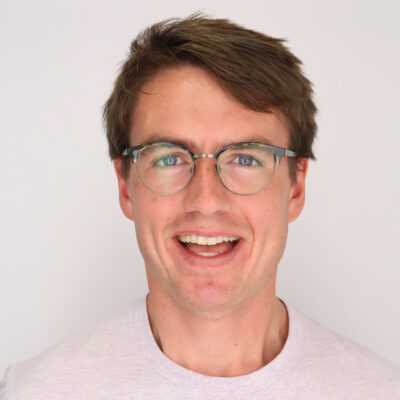
Joseph Van Linn is a doctoral candidate in civil and environmental engineering from Grand Haven, Michigan. He earned his B.Sc. at Michigan Tech and M.Sc. at Delft University of Technology and now studies seismic waves and earthquake processes under the guidance of Greg McLaskey at Cornell.
What is your area of research and why is it important?
I use sensors to study seismic waves and earthquake processes in laboratory experiments. Seismic waves encode information about Earth into their waveforms as they propagate through the planet. I decode this information, using it to constrain mechanical deformations that alter rocks’ behavior where the most destructive earthquakes occur in the top ~15 miles of Earth’s crust. Curiously, the wave speed in the crust fluctuates over time, changing on the order of ~1% over the course of months to years. At Cornell, I squeeze, shake, and saturate with water meter-scale granite sections, and measure alterations in wave speed as the rock’s properties are modified. These same changes occur beneath your feet both during and in-between earthquakes.
What are the larger implications of this research?
Earthquakes can topple buildings, cause landslides, induce tsunamis, and alter Earth’s surface, yet forecasting when and where earthquakes will occur is a mystery. Earthquakes transfer stored potential energy in Earth’s crust (strain energy) to abrupt slip events along faults. The abrupt slip generates seismic waves, and those waves travel faster in rocks that are squeezed and have more stored energy. Resolving what causes the wave speed to change in the crust may provide a means to monitor the amount of strain energy (i.e., the fuel) for earthquakes. Knowing the strain energy in a region prone to earthquakes will help improve earthquake forecasting.
What inspired you to choose this field of study?
I spent my undergraduate summers working as a forest firefighter for the federal government, stationed in central Oregon. The experience took me around the public lands of the American West and left me in awe of its beauty. I found myself always wondering why the landscape, forestry, and flora were the way they were. As a Ph.D. student focused on earthquakes, I get to endlessly learn about the Earth, and that brings me a lot of joy.
How did your Graduate School Research Travel Grant enable you to expand your research?
Research is a team effort. I used the Graduate School Research Travel Grant to build a team. My research is all about connecting what I observe in the lab to what is observed inside Earth. Prior to my trip to Padova, Italy, I did not truly understand how seismic wave speeds were measured in Earth’s crust. With funding from the grant, I was able to learn from an expert who makes such measurements. A year following this experience, I still consult this teammate to further my research.
What are your hobbies or interests outside of your research or scholarship?
I really enjoy being outside. During summer, I road and mountain bike, sail, and backpack in the Northeast United States. During winter, I telemark ski, including taking backcountry trips around the Northeast, and I do some informal instructing on the side. During that indecisive climate between summer and winter, I head to Lake Ontario on windy days for surfing. Indoors, thoughtful cooking is a staple to help me relax.
Why did you choose Cornell to pursue your degree?
Prof. McLaskey. When I weighed my Ph.D. offers, I ultimately decided the advisor was my most important criterion. I started my Ph.D. with the intention to learn how to do “good science.” Prof. McLaskey offered that to me. Also, having outdoor activities at my fingertips captured my attention.