
Student Spotlight: Katie Randolph
October 26, 2026
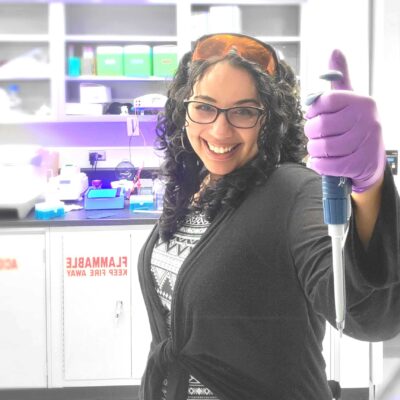
Katie Randolph is a doctoral candidate in biological and environmental engineering with a focus on biological physics from Las Vegas, Nevada. She earned her bachelor’s degree from the University of Las Vegas and master’s degree in physics at Washington University in St. Louis and now studies the spread and evolution of microbe communities under the guidance of Andrea Giometto at Cornell.
What is your area of research and why is it important?
Most microbes don’t live alone; they grow packed together in colonies and biofilms, like the slimy films on teeth, pipes, and medical implants. I study how these crowded communities spread and evolve. In an evolution experiment with yeast, we selected for faster-spreading colonies. All 10 populations found the same solution: a striking change from round to elongated cells, which helps colonies spread faster even though the cells reproduce more slowly. I connect single-cell traits, like shape, to how the whole colony behaves as a material. This suggests that in crowded settings, success depends on more than how fast cells divide.
What are the larger implications of this research?
Biofilms cause persistent infections and foul medical devices and pipes, but they also clean wastewater, ferment foods, and protect plant roots. Understanding how single-cell traits determine how a community spreads could let us intervene at the level of individual cells, slowing harmful biofilms or helping beneficial ones establish. More broadly, my work shows that in crowded populations, success depends on more than how fast cells divide. That insight may also help us understand how other dense, growing populations, such as tumors, expand and evolve.
What have you learned from participating in the Cornell Advancing Science and Policy Club (ASAP) and Scientist Network for Advancing Policy (SNAP)?
We’re living through tumultuous times, which can feel overwhelming. But uncertain times are also contingent ones: The choices we make every day can shape how this period turns out. Through ASAP and SNAP, I’ve learned how empowering it is to connect with people who believe science and our planet are worth standing up for and that learning to coordinate as a group is how ideas become change. Coming together, organizing, and working through disagreements is democracy in practice. Everyone has a role to play.
Why do you feel science communication is an important skill to develop?
I see it as part of my job as a scientist. We’re trained not only to discover how the world works, but to interpret what those discoveries mean, and that interpretation is exactly what people in other fields, and our communities, need from us. We shouldn’t leave them to figure it out alone. That’s the role I chose, and I take it seriously. Science only helps society if it’s understood, and communicating clearly is a skill that improves with practice.
What are your hobbies or interests outside of your research or scholarship?
Building community with people I love spending time with, and soaking up the beauty of the world around us. For me, yoga, lifting, craft beer, and stand-up comedy make life sparkle. Shout-out to Josh Johnson for helping me laugh my way through finishing a dissertation while sitting with the reality of this moment.
Why did you choose Cornell to pursue your degree?
I came for the people. I’ve been lucky to work with a wonderful advisor and research group, and over my Ph.D. I’ve grown into the independent scientist my younger self would be proud of.