
Student Spotlight: Lillian Lau
October 19, 2026
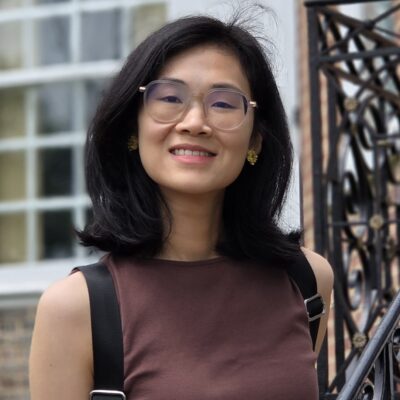
Lillian Lau is a doctoral candidate in civil and environmental engineering with a focus on environmental and water resource systems engineering from Subang Jaya, Malaysia. She earned a B.Sc. in civil and environmental engineering from the University of Illinois Urbana Campaign and an M.Sc. in civil and environmental engineering from Cornell University and now studies computational and decision support tools to help cities coordinate water management and investment planning under the guidance of Patrick Reed at Cornell.
What is your area of research and why is it important?
I develop computational and decision support tools that help cities safely coordinate their water management and investment planning to achieve shared supply reliability and limit their financial risk. As water resources become scarcer and infrastructure financing becomes harder to secure, water utilities are increasingly partnering to share water during drought and split the cost of new reservoirs and treatment plants. However, this creates risk for all cooperating utilities, particularly when one partner doesn’t follow through on supplying their share of water, delays a project, or generally acts differently than planned. The cooperative frameworks that are currently available are often difficult to understand for water utilities who already have so many other responsibilities to bear. It is therefore important to equip utilities with the necessary decision support tools that can help them achieve shared reliability and financial goals without making any individual utility more vulnerable to external risk.
What are the larger implications of this research?
Water utilities are turning to regional cooperation to mitigate and adapt to climate change and unpredictable population dynamics, but these partnerships can only hold up in the real world if everyone behaves exactly as planned. However, cooperating partners often have conflicting priorities and unequal access to supply and financial resources. Additionally, coordinated plans rarely unfold exactly as intended. My research therefore builds computational tools that combine artificial intelligence, visual analytics, and large-scale simulations. These tools provide utilities and decision makers with practical tools for designing cooperative water management and infrastructure investment plans that can meet both individual and shared goals even under challenging futures and imperfect implementation. Broadly speaking, my work highlights how cooperating utilities can achieve shared goals without sacrificing individual autonomy, facilitating the safe but simultaneously robust management of shared water resources.
What inspired you to choose this field of study?
One experience I keep going back to is my experience interning at a consulting firm where I worked on a proposal for restructuring water tariffs. My training as a civil engineer made me aware that we had all the tools necessary for the optimal and efficient financial and supply management of our water resources. However, after three years of being taught that every problem had an optimal solution, it was disorienting to see other “sub-optimal” but more acceptable tariff structure options be prioritized as they better suited the preferences and institutional constraints of the project’s key stakeholders. It became clear to me that optimality often concealed tradeoffs that were often not elicited until it came time to make the final decision. How a problem is formulated, how stakeholder preferences are elicited, and how a decision is understood and operationalized, all matter as much as, and sometimes even more so, than identifying a “perfect” solution. I therefore believe that it is important to make the discovery, navigation, and implementation of complex water resources planning and management decisions dynamic, adaptive, and explainable.
What does it mean to you to have been selected for MIT’s Rising Stars in Civil and Environmental Engineering: An Academic Career Workshop for Women?
Being selected as part of the 2027 cohort of MIT’s Rising Stars in Civil and Environmental Engineering is an invaluable opportunity to learn from a diverse network of peers and faculty further along the academic path. This workshop is unique as it serves as both a personal and professional development program, providing participants with a glimpse into how faculty balance the demands of the careers with their personal lives while acting as a less-formal simulation of what a typical campus visit for a job talk would feel like. I am hoping that the Rising Stars workshop will help me learn to ask the right questions and understand how I can navigate the challenges that come with being a woman in academia. Mostly, I’m excited to meet my peers from other institutions and learn about what their research is about!
What are your hobbies or interests outside of your research or scholarship?
I enjoy baking and cooking – it helps me stay connected to home and family. I typically like cooking traditional Malaysian foods but have recently been trying out NYT Cooking recipes (it’s free for Cornell students!) in my free time. The NYT Cooking’s plum torte recipe lives rent-free in my head. I also lead the syllabus development of RakanTutor as a digital platform director, which is a nonprofit aimed at providing AI education for Malaysian youth through in-person workshops and online, bite-sized learning modules. Outside of that, I regularly do yoga and Zumba.
Why did you choose Cornell to pursue your degree?
I chose Cornell because it felt like my research interests and working style strongly aligned with that of my advisor, Pat Reed, and the overall lab, who were and have been incredibly supportive since day one. Cornell also has a long tradition of research across artificial intelligence and water resources systems management under uncertainty, both of which are core aspects of my research. On a lighter note, I completed my B.Sc. in Urbana-Champaign, and by the end of my four years there I really, REALLY wanted to be on a campus with at least one hill. I guess I got what I wished for (and more).