
Student Spotlight: Rose Brown

September 21, 2026
Rose Brown is a doctoral candidate in psychological sciences and human development with a focus on social and personality psychology from Kingstown, North Carolina. She earned her previous degrees at the University of North Carolina at Charlotte, University of Pennsylvania, and University of North Carolina at Chapel Hill and now studies organizational justice under the guidance of Will Hobbs at Cornell.
What is your area of research and why is it important?
My research focuses on organizational justice, how people respond when they experience mistreatment at work and what they believe should happen afterward. I study the different ways employees pursue justice, whether through formal complaint processes, leaving an organization, or pursuing accountability through other means. I am particularly interested in what happens when people feel that existing systems have failed to address workplace harm. Understanding these responses is important because perceptions of justice shape employee well-being, organizational trust, workplace relationships, and whether conflicts are resolved or escalate into more serious problems
What are the larger implications of this research?
Across multiple projects, I find that persistent mistreatment, unresolved complaints, and perceived organizational inaction can contribute to negative emotional and physical impacts on the employee victim, including depression, weight gain, and insomnia. These organizational contexts can also lead to employee turnover, and, in some cases, more serious forms of escalation such as workplace violence. These findings encourage organizations to view complaint systems not simply as compliance requirements but as important tools for preventing harm, reducing the risk of escalation, and strengthening a culture of workplace accountability. More broadly, my work highlights how organizational decisions influence whether people feel heard, supported, and treated justly, with consequences for employees, organizations, and the communities they serve.
Can you describe the process of transforming your dissertation into a TEDx talk?
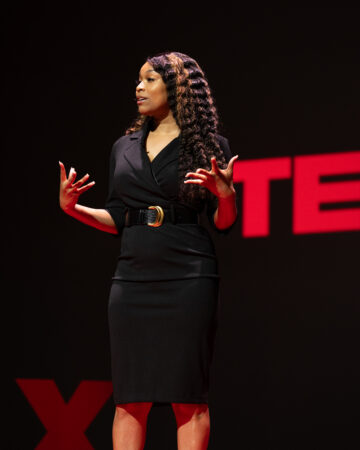
Transforming my dissertation into a TEDx talk was one of the most challenging communication experiences of my academic career, and I am currently writing my Ph.D. dissertation. The TEDx coaches repeatedly told me my drafts read like a journal article, which, after years of training to write exactly that way, was at times disorienting. Translating highly technical interdisciplinary research into language accessible to someone who may not hold a college education or a high school diploma requires a completely different kind of intellectual discipline and code-switching. I rewrote that talk more times than I can count, memorized 11-plus minutes without a teleprompter, and absorbed various feedback from multiple coaches simultaneously. At times, it felt like having a second dissertation committee. Ultimately, the experience challenged me to think differently about research communication and made me a stronger scholar, storyteller, and public speaker.
What skills did you develop or strengthen through the TEDx process, and how do you see those skills supporting your professional development?
The TEDx experience strengthened my ability to communicate complex research clearly and effectively to diverse audiences. It challenged me to move beyond academic writing and develop messages that could resonate with students, practitioners, community members, and organizational leaders alike. The process also improved my public speaking, storytelling, and audience-engagement skills, especially because the talk had to be delivered from memory. As I prepare to enter the academic job market, these skills will help me communicate my research more effectively, teach students from varied backgrounds, and build connections between scholarship and real-world practice.
What are your hobbies or interests outside of your research or scholarship?
Outside of research, I enjoy volunteering, photography, woodworking, hiking, and playing the drums. Community service is especially important to me. I enjoy supporting local organizations, serving meals at shelters, and helping coordinate birthday celebrations for children experiencing homelessness. These experiences allow me to connect with people outside of academia and remind me why creating positive change matters. I also enjoy exploring museums, art galleries, and new vegetarian and vegan foods. Together, these interests help me stay grounded, creative, and connected to the communities that inspire much of the work I do.
Why did you choose Cornell to pursue your degree?
I chose Cornell because of its community. I was especially drawn to the opportunity to learn from faculty whose work I admired and to be part of a community that values both rigorous scholarship and meaningful impact. Furthermore, my research is highly interdisciplinary, and Cornell has provided opportunities to connect with scholars across departments and fields while I develop as both a researcher and an educator. I also knew Cornell would challenge me intellectually and professionally. Throughout my Ph.D., I have been inspired by colleagues, mentors, and students who are doing remarkable work in and beyond the academy, and it has been a privilege to grow alongside them.