
Finding the Right Fit: Alum Shares Wisdom from Career Journey
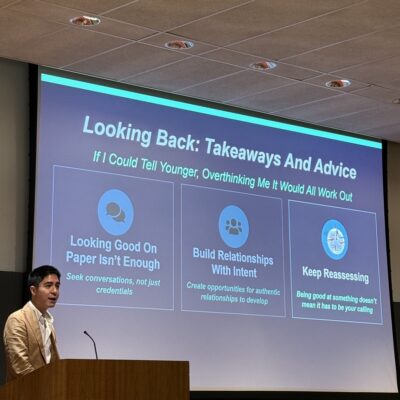
Jason Marvin, Ph.D. '22, gives the alumni keynote at the 2026 Summer Success Symposium.
August 21, 2026
By Katya Hrichak
Sometimes the path you think you’ll follow after you leave grad school isn’t the path you end up taking—and that’s okay.
During the Summer Success Symposium alumni keynote session on Aug. 18, Jason Marvin, Ph.D. ’22, spoke about his journey from earning his doctorate in biomedical engineering with the goal of becoming a professor to instead becoming director of partnerships and external relations at the American Institute for Medical and Biological Engineering.
“What I do now is nothing that I imagined I would be doing during my graduate training, and it wasn’t even something that was on my radar until much later,” he said during the talk, titled, “Finding Your Way: A Scientist’s Serendipitous Career Path from Academia to Science Advocacy.”
He came to Cornell with the desire to become a professor with a lab full of students to teach and mentor, and he worked hard to get there: completing a Center for Teaching Innovation teaching fellowship, doing outreach with K-12 students as a member of GRASSHOPR (Graduate Student School Outreach Program), and lending his time to teach during Girl Scout Engineering Day and Curie Academy.
“My desire to be a professor never wavered,” Marvin said.
But something started to shift when the COVID-19 pandemic hit and the U.S. simultaneously experienced racial violence that shook the country. It was during that time when self-advocacy and advocacy for his students became more of a focus for Marvin.
“It was a really big learning point for me in terms of how to bring my full, authentic self to work,” he said. “That was something that I really wanted to embrace and lead by example. Cornell was that place that allowed me to grow into that kind of role as a scholar, and I think it is really important thinking about these identities and how they’re always interplaying. I’m a scientist, first and foremost, but I’m also an advocate and a community builder. These are not separate from each other. I think they can very much exist in harmony.”
Eventually, when completing a postdoc at Harvard University, the confluence of these identities led Marvin in a new direction—away from the professorial career he had always dreamed of.
“On paper, I felt like things went really well. I was thriving as a scientist, but I felt like some things were off,” he said. “I sat through those options in front of me, and I thought, I just don’t feel the excitement that I feel like I should be experiencing right now.”
What Marvin did next—and encouraged the students in attendance to do—was reflect on what brought him joy during his grad school experience and what gave him a sense of purpose. For him, it was working with students, organizing events, and spending time in the science communication space.
“I thought, I spent so much of my time as it is on these things outside of the lab. What would it look like if I just had a career doing this full time? That was kind of the mental shift that I had to have,” he said.
He dove into a new job search, leveraging LinkedIn as well as the many connections he formed during his years as a grad student through conferences and other networking opportunities. It was by reaching out to one of these individuals that he ultimately found a job that “checked all the boxes” for him.
Students interested in identifying a meaningful career are encouraged to consider the following takeaways from Marvin’s journey:
- Pay attention to what makes you happy and what gives you a sense of purpose as you progress through grad school.
- Find a balance between time and energy spent on your academic program and opportunities that help you fulfill that sense of purpose.
- Form meaningful professional connections with individuals in your field and other areas of interest.
- Don’t be afraid to pivot away from what you thought you were going to do in order to embrace something new.
“This isn’t really about abandoning the career path I sought out,” Marvin said. “It’s actually just a different version.”
This year’s Summer Success Symposium also featured an opening plenary session, “Navigating Mentoring Relationships: Challenges, Opportunities, and Considerations,” a flash talk and engagement session, “Caring for Your Health and Well-being;” and a closing plenary workshop, “The Why Behind the Work.”
This event was sponsored by the Graduate School Office of Inclusion and Student Engagement, the Cornell Duffield College of Engineering Office of Inclusive Excellence, and the Cornell Chapter of the Bouchet Graduate Honor Society and was modeled in part after PROMISE: Maryland’s AGEP Summer Success Institute. The launch and institutionalization of the Summer Success Symposium benefited from support from the 2016 ETS/CGS Award for Innovation in Promoting Success in Graduate Education and NSF under Award No. 1647094, CIRTL AGEP Transformation Alliance from 2016-2022.